Seagull
Mariners' Museum, Uncurated Search Results
Type: Skipjack
Year: 1924
Builder: C. A. Dana
Location: Crisfield

These records are found in the online catalog of The Mariners’ Museum and Park in Newport News, Virginia. Uncurated search results are presented to give researchers and interested readers an idea of whether the museum’s archives contain information about this vessel and whether it may be worthwhile to visit the museum’s catalog search page for further investigation. Uncurated results may be inaccurate or incomplete.
Search mode: Exact Name. Search phrase(s): "Seagull". Results returned: 30. Results displayed in this table: 30.
Use these buttons to send uncurated search results to your own app or text document for further research. First, check the box for any row, or click "Select All" then uncheck any rows. Then click "Show Selections". You can then copy your selections from the text box and past them into your app.
| Fetch? | Row ID | Media | Date | Vessel | Place | Related Places | Inscription/Marks | Subject | Notes | Archive Number |
|---|---|---|---|---|---|---|---|---|---|---|
| 1 | No image URL. | Robinson Seagull cruiser. | LB84914 | |||||||
| 2 | No image URL. | The saga of a seagull. | LB42823 | |||||||
| 3 | No image URL. | BRACKET, BRITISH SEAGULL OUTBOARD ENGINE | CL23797 | |||||||
| 4 | No image URL. | NOTES: Serial #S82B6 | CL21983 | |||||||
| 5 | No image URL. | British Seagull (Firm). | Outboard motors–Maintenance and repair.; Outboard motors–Prices–Catalogs. | The collection consists of a Seagull Outboard Motor Handbook (n.d.); a Seagull Outboard information flyer (1979?); and a British Seagull Outboard Motor catalog (c. 1950s). | MS0497 | |||||
| 6 | 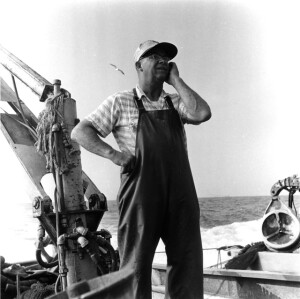 | 1963 | USA; VIRGINIA | WRITTEN ON VERSO: CAPTIAN LEWIS ON RADIO WITH SPOTTER PLANE | CURATOR NOTES: View of Captain Lewis wearing rain coveralls speaking to spotter plane on the radio. A seagull flies over head in the background. | P0001.016/01-#PP2524 | ||||
| 7 | 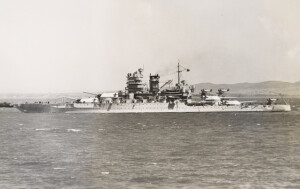 | 1925 | Mississippi (Battleship : BB-41). | Mississippi BB41 Newport News SB Co. Newport News, VA. B.12-18-1917 | Port broadside view of BB-41 slowly underway; land is in the background. Three SOC Seagull observation float planes are visible on the ship's catapults. | P0008/01-#PN12634 | ||||
| 8 | 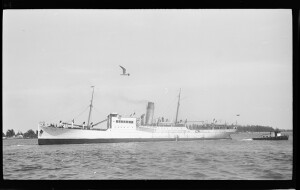 | 1883-1931 | Colister (Steamship : 1942). | Colister 1908 Ex "Southern Lady", "Far North", "Hethpool", "Richard Welford"; At Miami, Fla. | Miami skyline with the steamer Colister in the foreground. A seagull can be seen passing over Colister. | MS0091/03.01-15#003 | ||||
| 9 | No image URL. | Great Britain. Royal Navy–History | Great Britain–History, Naval. | Text, ill on lining papers. | LB39804 | |||||
| 10 | No image URL. | Bergenske : __byen og selskapet. | LB109040 | |||||||
| 11 | 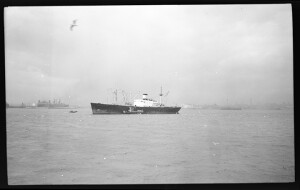 | 1883-1931 | Cape Charles 1942; U.S. War Shipping Adm[inistration]. Clyde-Mallory Line; (Nov. 12, 1946) | Broadside view of the steamer Cape Charles underway. A seagull was captured in upper left corner frame in mid-flight. | MS0091/03.01-08#099 | |||||
| 12 | No image URL. | S-2 Yachts, Sabre/Sabreline/Sabre Yachts, Scarab Offshore, Scout Boats, SeaBird Yacht Corp., Sea Cat, SeaCraft Inc., Sea Doo, Seafox Yachts, Seagull Boats, Sea Ox, Sea-Pro Boats, Sea Ray | MS0379/-14 | |||||||
| 13 | No image URL. | SHORT DESCRIPTION: Triangular souvenir wall pennant with image of ferry, lighthouse, buoy, seagull and logo. | CL7447 | |||||||
| 14 | 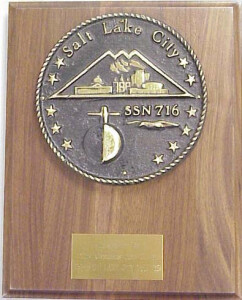 | SHORT DESCRIPTION: Wood class award plaque. Wood plaque with circular brass seal and plate on front. Seal shows a stylized view of Salt Lake city with mountains in the background. There is a submarine in the bottom left quadrant and a seagull in the bottom right quadrant. A rope design circles the outside edge. There are a number of stars near the rope design. There is a small brass presentation plate at the base of the plaque. VESSEL INFORMATION - VESSEL NAME: SALT LAKE CITY (SSN716) VESSEL TYPE: SUBMARINE SHIPBUILDER: NEWPORT NEWS SHIPBUILDING & DRY DOCK CO. BUILDER LOCATION: NEWPORT NEWS, VIRGINIA VESSEL LAUNCHED: 10/16/1982 VESSEL COMMISSIONED: 05/12/1984 VESSEL DIMENSIONS: LENGTH OA.362'0"; 33'0" BEAM; 6,098 DISPL. | CL28610 | |||||||
| 15 | No image URL. | World War, 1914-1918–Naval operations.; Q-ships.; World War, 1914-1918–Naval operations–Submarine. | Sea killers in disguise : __the story of the Q-ships and decoy ships in the First World War __by Tony Bridgland | LB97049 | ||||||
| 16 | 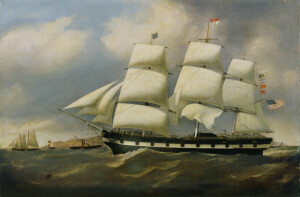 | RESEARCHER'S NOTES: This is definitely by McFarlane - no signature is visible . The McFarlane trademark is the seagull over the water, combined with the figure on the poop deck with a telescope (May 10, 1977, Stephen M. Riley, National Maritime Museum, Greenwich.) CURATOR'S NOTES: Revell Carr of Mystic believes this painting may be by McFarlane -he notes the figures in the rigging, the man with the spy glass, water, etc....J. Sands 11/15/75. VESSEL INFORMATION - VESSEL NAME: MEDIATOR ALL SHIP'S NAMES: (1) MEDIATOR (1836-1860), (2) DROGHEDA (1861-1874). VESSEL BUILDER: WESTERVELT & SON, JACOB A. BUILDER LOCATION: WILLIAMSBURG (L.I.), NEW YORK SHIP OWNERS: BLACK X LINE 1836-1843; UNION LINE (WILLIAM T. FROST)(NEW ORLEANS PACKET, 1849-1860; TAYLOR & FERGUSON, 1861-1874 VESSEL DIMENSIONS: 138'4" L x 32'5" B x 21' depth of hold, 660 tons | CL11513 | |||||||
| 17 | 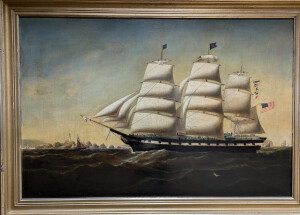 | NOTES: Sam Davidson 9/22/95, Style and his way of depicting the Skerries (shared by W.G. York), Marryat Code at the mizzen reads correctly 2/6093. Liverpool bound off the Skerries (under bowsprit), red star on blue swallowtail ground. At foremast U.S. Jack 'requesting a pilot' restoration around the hull- no tophatted captain! But his typical seagull, I think a definite early McFarlane.*** NOTES: J. Sands 11/25/75: Revell Carr of Mystic believes this picture may be by McFarlane. VESSEL INFORMATION - VESSEL NAME: PRINCETON SHIP BUILDER: JABEZ WILLIAMS BUILDER LOCATION: WILLIAMSBURG, NEW YORK VESSEL DIMENSIONS: 176'7" X 38'8" B X 29'6"" DEPTH OF HOLD, 1,127 TONNAGE, 1,349 GROSS TONNAGE | CL11514 | |||||||
| 18 | 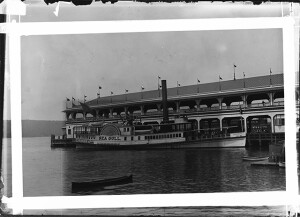 | 8/8/1903 | Steamboats–United States.; Bodies of water–United States.; Paddle steamers–United States. | Shows the side wheel steamer Sea Gull at pier. | MS0095/02-#1162 | |||||
| 19 | 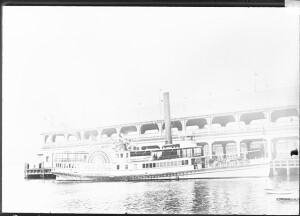 | Circa 1905 | Steamboats–United States.; Bodies of water–United States.; Paddle steamers–United States. | Shows the side wheel steamer Sea Gull at pier. | MS0095/02-#1161 | |||||
| 20 | 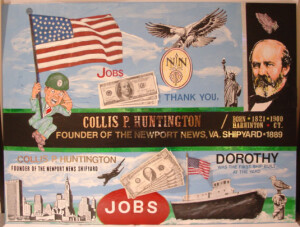 | SHORT DESCRIPTION: Acrylic and latex paint on masonite. The painting includes four distinct areas. At the top left is a large American flag held by man wearing a suit and hard hat, an eagle with outstretched wings and talons soaring over the NNSDD logo, the Statue of Liberty, and an applied set of various denominations of US currency. At the upper right is an image of Collis Huntington and an image of clapping hands. At the lower left is a cityscape with a plan soaring overhead. At the center bottom is the word "jobs" and a stack of applied $10 bills. At the bottom right is a stylized image of the tugboat Dorothy carrying a large American flag and an image of a seagull on a piling. NOTES: [Curator Thomas Moore, July 11, 2008] Mr. Welch predominantly made his living as a professional sign painter residing in Newburyport, New York and New York City before moving to Newport News in 1996. His painted collages incorporate hand painted text, portraits and backgrounds, quotes referring to historical events, photocopied images, applied lettering, stickers and decorative fabric elements. His work shows little influence from the mainstream art world and instead is motivated by his personal visions. Mr. Welch's body of work recognizes the importance and accomplishments of African American political and cultural figures, artists and musicians. His depictions of Collis Huntington and William Frick were included because according to Mr. Welch "they treated everybody right". NOTES: [From flyer produced by artist] To Whom it May Concern: The Artist and sign painting, Mr. John Edward Welch, was born, August 9, 1918 in Winfall, North Carolina. His father was a building contractor. His mother played the piano and organ. She also designed and made her own clothes. Mr. John Edwards served in World War II. He also went to Korea for the United States millitary. His back ground for his profession includes attending Virginia State College (Drafting, etc.) and New York University (teaching, profession, etc.). Mr. Welch worked with and was trained by experts. He also trained many youths with on the job training and paid for their assistance. | CL29617 | |||||||
| 21 | 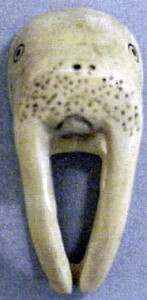 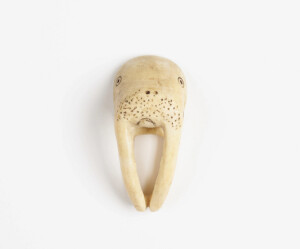 | SHORT DESCRIPTION: Carved walrus head with tusks. Dotted eyes inside circles, nostrils, mouth, and whiskers are inked in black. NOTES: This ivory walrus head hunting charm was probably once part of a Yup’ik or Aleut hunting visor. They were usually mounted on the front middle of a visor. From Smithsonian’s Alaska Native Collections, Arctic Studies Center: Hunters of the Bering Sea coast wore wooden visors to protect their eyes from glare and to spiritually assist with the hunt. To make a visor a craftsman used hot water to soften the wood, then bent it around and stitched the ends together with sinew, baleen, or split root. Animal carvings were added as hunting charms, such as the walrus and seagull heads. NOTES: (Old Accession#s: IS 289, IS 291, IS 292, IS 294, IS 299, IS 300, IS 301, IS 303, IS 305, IS 306, IS 307, IS 309, IS 310, IS 312, IS 314, IS 315, IS 316, IS 318, IS 320, IS 322, IS 323, IS 324, IS 326, IS 327, IS 328) These small ivory carvings may have been used to decorate ceremonial bowls or pails or for use as charms. They represent whales, seals, walruses, and other animals. The carvings on a bowl may represent one man’s lifetime of hunting and visionary encounters at sea. Hunters used carved charms in the shape of animals to gain the cooperation of animal spirits. They wore the small carvings around their necks, on belts, and in their clothing and fastened others to hunting equipment and boats. The charms had various powers – to guide hunters to game or to give them sharper vision, to attract animals, or to make weapons more effective. NOTES: The objects with the accession number 1937.19 were purchased as a single lot by Museum buyer Isabel Redpath in December 1936/January 1937. There were originally 260 items in the lot (only 160 or so remain in the collection). Many of the items have what look like accession or tracking numbers applied to them with black ink. Within the collection is a fish hook (WF 46) that was originally in the Smithsonian collection, but was sent to the Glen Island Museum at some point after its acquisition. The materials in the Glen Island Museum were collected by John H. Starin. The Glen Island Museum was closed and the collection was sold to Harry Hagerty of New York in June 1915. The collection was later resold by auctioneer Elliott A. Haaseman in sales occurring on October 17-21, 1921. While a search of the auction catalog did not reveal a large collection of Alaskan native made items it’s not out of the realm of possibility that these materials came from the collection of the defunct museum. | CL2605 | |||||||
| 22 | 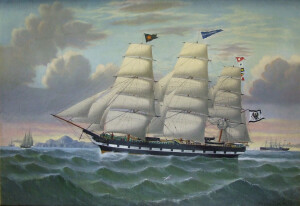 | NOTES: Sam Davidson, 9/22/95 Off Point Lynas meeting a pilot. Very nice early William York L' pl June1863 GREAT EASTERN on right. 5f. &6m- Prussian ensign black eagle white ground black border top & bottom, Marryat 3/1863 gives ARNOLD BOLLINGER. Point Lynas Lighthouse & Parys Mountain under bowsprit, pilot schooner 3 approaching H. flag nice green-blue ground 5 pointed star & central 'orange'. Typical early seagull, and bow & stern reflections. *** VESSEL INFORMATION- From Artuk.org: The ARNOLD BONINGER was registered in Duisburg under the Prussian flag after being built at Vegesack, which is a suburb of Bremen, in the period 1852 to 1857. It was surveyed at Rotterdam in May 1857 as first class (hull and stores). It's first captain was J. D. Hashagen and it was build for its owner, Arnold Boninger, of oak on an iron frame. It had two decks (an internal cargo deck above the hold, as well as an upper deck), drew 18 feet loaded, and was intended for Atlantic voyages. Details from 'Registre Veritas' for January 1858 (international version of Lloyds Register). Additional information found states the Prussian full rigged ship Arnold Boninger was built at Vegesack/Grohn by Johann Lange for the Boninger tobacco firm, in Duisburg, and was launched on May 1, 1852. Between July 27, 1852 and May 2, 1870 the ship made twenty-six voyages between Rotterdam, Bremen and Havre and New York and Baltimore. The ship was sold and renamed Jason in 1872. VESSEL INFORMATION - VESSEL NAME: GREAT EASTERN VESSEL BUILT: 1859-1887 VESSEL TYPE: STEAMSHIP VESSEL BUILDER: SCOTT, RUSSELL & CO. SHIPBUILDER LOCATION: MILLWALL, LONDON VESSEL DIMENSIONS: 18,915 register tonnage, 20,150 tonnage, 678' x 83' x 24'. SHIP LINE: GREAT EASTERN STEAMSHIP CO. VESSEL HISTORY: Paddle wheels and a single screw, speed: 13 knots. Six masts and five funnels. Launched in 1858. She was to have been called the LEVIATHAN, but was christened the GREAT EASTERN. The cost of launching the ship exhausted the owners funds, and she lay unfinished for a year. A new company was formed and they had her completed in September, 1859. Her building costs amounted to about $5,000,000. Commenced her maiden voyage for New York on June 17, l860. Her employment as an Atlantic liner was short duration. Later was used to lay the Atlantic cable. Broken up by shipbreakers in 1891 (Smith, Eugene, "Trans-Atlantic Passenger Ships Past and Present"). | CL8769 | |||||||
| 23 | 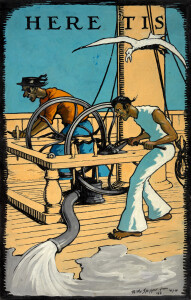 | SHORT DESCRIPTION: Caricature showing sailors operating deck bilge pump on a large sailing vessel. NOTES: Item number 64 Hague Catalogue. | CL26356 | |||||||
| 24 | 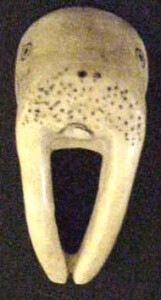 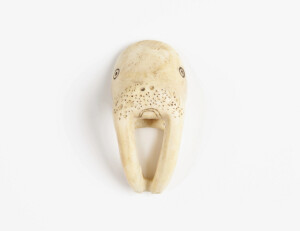 | SHORT DESCRIPTION: Carved walrus head with tusks. Dotted eyes inside circles, nostrils, mouth with two lines, and whiskers are inked in black. NOTES: This ivory walrus head hunting charm was probably once part of a Yup’ik or Aleut hunting visor. They were usually mounted on the front middle of a visor. From Smithsonian’s Alaska Native Collections, Arctic Studies Center: Hunters of the Bering Sea coast wore wooden visors to protect their eyes from glare and to spiritually assist with the hunt. To make a visor a craftsman used hot water to soften the wood, then bent it around and stitched the ends together with sinew, baleen, or split root. Animal carvings were added as hunting charms, such as the walrus and seagull heads. NOTES: (Old Accession#s: IS 289, IS 291, IS 292, IS 294, IS 299, IS 300, IS 301, IS 303, IS 305, IS 306, IS 307, IS 309, IS 310, IS 312, IS 314, IS 315, IS 316, IS 318, IS 320, IS 322, IS 323, IS 324, IS 326, IS 327, IS 328) These small ivory carvings may have been used to decorate ceremonial bowls or pails or for use as charms. They represent whales, seals, walruses, and other animals. The carvings on a bowl may represent one man’s lifetime of hunting and visionary encounters at sea. Hunters used carved charms in the shape of animals to gain the cooperation of animal spirits. They wore the small carvings around their necks, on belts, and in their clothing and fastened others to hunting equipment and boats. The charms had various powers – to guide hunters to game or to give them sharper vision, to attract animals, or to make weapons more effective. NOTES: The objects with the accession number 1937.19 were purchased as a single lot by Museum buyer Isabel Redpath in December 1936/January 1937. There were originally 260 items in the lot (only 160 or so remain in the collection). Many of the items have what look like accession or tracking numbers applied to them with black ink. Within the collection is a fish hook (WF 46) that was originally in the Smithsonian collection, but was sent to the Glen Island Museum at some point after its acquisition. The materials in the Glen Island Museum were collected by John H. Starin. The Glen Island Museum was closed and the collection was sold to Harry Hagerty of New York in June 1915. The collection was later resold by auctioneer Elliott A. Haaseman in sales occurring on October 17-21, 1921. While a search of the auction catalog did not reveal a large collection of Alaskan native made items it’s not out of the realm of possibility that these materials came from the collection of the defunct museum. | CL2575 | |||||||
| 25 | 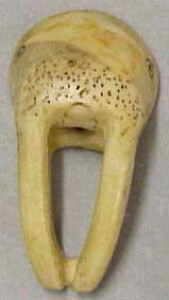 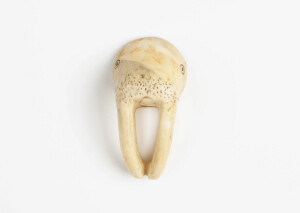 | SHORT DESCRIPTION: Carved walrus head with tusks. Dotted eyes inside circles, nostrils, mouth, and whiskers are inked in black. NOTES: This ivory walrus head hunting charm was probably once part of a Yup’ik or Aleut hunting visor. They were usually mounted on the front middle of a visor. From Smithsonian’s Alaska Native Collections, Arctic Studies Center: Hunters of the Bering Sea coast wore wooden visors to protect their eyes from glare and to spiritually assist with the hunt. To make a visor a craftsman used hot water to soften the wood, then bent it around and stitched the ends together with sinew, baleen, or split root. Animal carvings were added as hunting charms, such as the walrus and seagull heads. NOTES: (Old Accession#s: IS 289, IS 291, IS 292, IS 294, IS 299, IS 300, IS 301, IS 303, IS 305, IS 306, IS 307, IS 309, IS 310, IS 312, IS 314, IS 315, IS 316, IS 318, IS 320, IS 322, IS 323, IS 324, IS 326, IS 327, IS 328) These small ivory carvings may have been used to decorate ceremonial bowls or pails or for use as charms. They represent whales, seals, walruses, and other animals. The carvings on a bowl may represent one man’s lifetime of hunting and visionary encounters at sea. Hunters used carved charms in the shape of animals to gain the cooperation of animal spirits. They wore the small carvings around their necks, on belts, and in their clothing and fastened others to hunting equipment and boats. The charms had various powers – to guide hunters to game or to give them sharper vision, to attract animals, or to make weapons more effective. NOTES: The objects with the accession number 1937.19 were purchased as a single lot by Museum buyer Isabel Redpath in December 1936/January 1937. There were originally 260 items in the lot (only 160 or so remain in the collection). Many of the items have what look like accession or tracking numbers applied to them with black ink. Within the collection is a fish hook (WF 46) that was originally in the Smithsonian collection, but was sent to the Glen Island Museum at some point after its acquisition. The materials in the Glen Island Museum were collected by John H. Starin. The Glen Island Museum was closed and the collection was sold to Harry Hagerty of New York in June 1915. The collection was later resold by auctioneer Elliott A. Haaseman in sales occurring on October 17-21, 1921. While a search of the auction catalog did not reveal a large collection of Alaskan native made items it’s not out of the realm of possibility that these materials came from the collection of the defunct museum. | CL2607 | |||||||
| 26 | 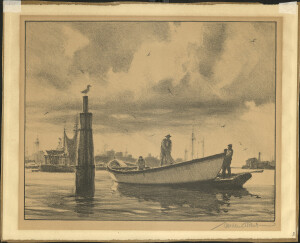 | SHORT DESCRIPTION: Lithograph by Gordon Grant depicting a seine boat in a harbor. Two men stand in the boat working with the nets while another man in a small rowboat on the port side assists. There is a tall piling on the starboard side of the boat with a seagull standing on top. In the background are fishing vessels and the buildings of the harbor. Stormy looking clouds and a lot of seagulls are overhead. The artists signature is at the lower right. NOTES: A label on the back of the frame (the label is in the object file, the frame was not kept) contains the following information: "Between Tides", a limited edition signed original lithograph by Gordon Grant. Briefly concerning the artist- Gordon Grant, born in San Francisco, was sent by his parents along around Cape Horn at thirteen to England to study at Lambeth and Heatherley's art schools there. Later Grant came to New York, concentrated on the sea and its ships and people, now has a reputation unique in American art. Grant spends most of his time along the sea at Martha's Vineyard, Nantucket, Gloucester and the Cape, knows the seamen as friends. He is a member of the National Academy, Society of American Etchers, the American Water Color Society, the Salmagundi Club, National Arts Club, Allied Artists of America, New York Water Color Society, Chicago Society of Etchers, Philadelphia Water Color Club. The Library of Congress and most museums own his works. Scores of volumes about the sea are illustrated by him including "Book of Old Ships" and "Forty Famous Ships". Scores of awards, exhibitions and honors have been heaped on this most noted artist of the sea and its people. Associated American Artists, 711 Fifth Avenue, New York 22, N.Y. | CL31191 | |||||||
| 27 | 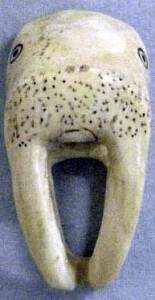 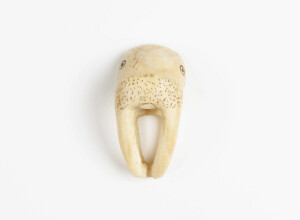 | SHORT DESCRIPTION: Carved walrus head with tusks. Dotted eyes inside circles, nostrils, mouth, and whiskers are inked in black. NOTES: This ivory walrus head hunting charm was probably once part of a Yup’ik or Aleut hunting visor. They were usually mounted on the front middle of a visor. From Smithsonian’s Alaska Native Collections, Arctic Studies Center: Hunters of the Bering Sea coast wore wooden visors to protect their eyes from glare and to spiritually assist with the hunt. To make a visor a craftsman used hot water to soften the wood, then bent it around and stitched the ends together with sinew, baleen, or split root. Animal carvings were added as hunting charms, such as the walrus and seagull heads. NOTES: (Old Accession#s: IS 289, IS 291, IS 292, IS 294, IS 299, IS 300, IS 301, IS 303, IS 305, IS 306, IS 307, IS 309, IS 310, IS 312, IS 314, IS 315, IS 316, IS 318, IS 320, IS 322, IS 323, IS 324, IS 326, IS 327, IS 328) These small ivory carvings may have been used to decorate ceremonial bowls or pails or for use as charms. They represent whales, seals, walruses, and other animals. The carvings on a bowl may represent one man’s lifetime of hunting and visionary encounters at sea. Hunters used carved charms in the shape of animals to gain the cooperation of animal spirits. They wore the small carvings around their necks, on belts, and in their clothing and fastened others to hunting equipment and boats. The charms had various powers – to guide hunters to game or to give them sharper vision, to attract animals, or to make weapons more effective. NOTES: The objects with the accession number 1937.19 were purchased as a single lot by Museum buyer Isabel Redpath in December 1936/January 1937. There were originally 260 items in the lot (only 160 or so remain in the collection). Many of the items have what look like accession or tracking numbers applied to them with black ink. Within the collection is a fish hook (WF 46) that was originally in the Smithsonian collection, but was sent to the Glen Island Museum at some point after its acquisition. The materials in the Glen Island Museum were collected by John H. Starin. The Glen Island Museum was closed and the collection was sold to Harry Hagerty of New York in June 1915. The collection was later resold by auctioneer Elliott A. Haaseman in sales occurring on October 17-21, 1921. While a search of the auction catalog did not reveal a large collection of Alaskan native made items it’s not out of the realm of possibility that these materials came from the collection of the defunct museum. | CL2600 | |||||||
| 28 | 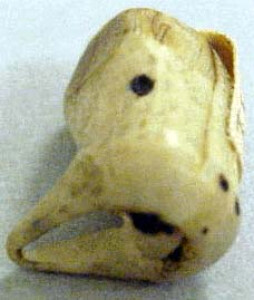 | SHORT DESCRIPTION: Carved walrus head with eyes, ears, and mouth inked in black. NOTES: This ivory walrus head hunting charm was probably once part of a Yup’ik or Aleut hunting visor. They were usually mounted on the front middle of a visor. From Smithsonian’s Alaska Native Collections, Arctic Studies Center: Hunters of the Bering Sea coast wore wooden visors to protect their eyes from glare and to spiritually assist with the hunt. To make a visor a craftsman used hot water to soften the wood, then bent it around and stitched the ends together with sinew, baleen, or split root. Animal carvings were added as hunting charms, such as the walrus and seagull heads. NOTES: (Old Accession#s: IS 289, IS 291, IS 292, IS 294, IS 299, IS 300, IS 301, IS 303, IS 305, IS 306, IS 307, IS 309, IS 310, IS 312, IS 314, IS 315, IS 316, IS 318, IS 320, IS 322, IS 323, IS 324, IS 326, IS 327, IS 328) These small ivory carvings may have been used to decorate ceremonial bowls or pails or for use as charms. They represent whales, seals, walruses, and other animals. The carvings on a bowl may represent one man’s lifetime of hunting and visionary encounters at sea. Hunters used carved charms in the shape of animals to gain the cooperation of animal spirits. They wore the small carvings around their necks, on belts, and in their clothing and fastened others to hunting equipment and boats. The charms had various powers – to guide hunters to game or to give them sharper vision, to attract animals, or to make weapons more effective. NOTES: The objects with the accession number 1937.19 were purchased as a single lot by Museum buyer Isabel Redpath in December 1936/January 1937. There were originally 260 items in the lot (only 160 or so remain in the collection). Many of the items have what look like accession or tracking numbers applied to them with black ink. Within the collection is a fish hook (WF 46) that was originally in the Smithsonian collection, but was sent to the Glen Island Museum at some point after its acquisition. The materials in the Glen Island Museum were collected by John H. Starin. The Glen Island Museum was closed and the collection was sold to Harry Hagerty of New York in June 1915. The collection was later resold by auctioneer Elliott A. Haaseman in sales occurring on October 17-21, 1921. While a search of the auction catalog did not reveal a large collection of Alaskan native made items it’s not out of the realm of possibility that these materials came from the collection of the defunct museum. | CL2606 | |||||||
| 29 | 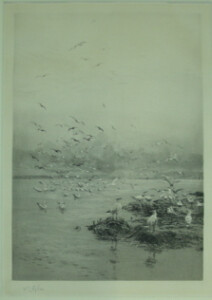 | SHORT DESCRIPTION: Aquatint of the Solent showing seagulls on rocks. The gulls are also flying through the air filling the space. NOTES: The Solent is the straight that passes to the north of the Isle of Wight in southern England. Portsmouth and Gosport are on the eastern side where the straight meets back up with the English Channel. NOTES: William Lionel Wyllie was born July 5, 1851 in London. He studied art at Heatherley’s, then the Royal Academy Schools. He began winning awards at age 18, and exhibited his artwork at the Fine Art Society and the Royal Academy. He married Marion A. Carew in Switzerland on July 31, 1879, and they went on to have nine children. During WWI Wyllie received permission to sail with the Royal Navy, drawing the various ships and events that he witnessed, which he detailed in his book Seafights of the Great War. His work during the late Victorian period and early 20th century focused on seascapes and landscapes, but also on the various military, commercial, and pleasure ships that he watched on the water. He also worked with White Star Line, Union Castle Line, and Orient Company to draw ship portraits and travel posters. Later in life he was instrumental in the restoration of HMS Victory, using the proceeds from his artwork to help raise awareness and support the work. In 1930 at age 79 he painted a 42’ panorama of the Battle of Trafalgar, which is still on display today at the National Museum of the Royal Navy at Historic Portsmouth Dockyard. Wyllie died April 6, 1931 and was buried with full naval honors. | CL28937 | |||||||
| 30 | 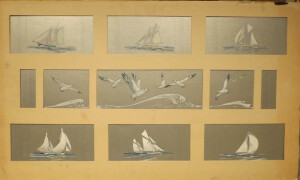 | SHORT DESCRIPTION: Gouache or water paint on a silver background depicting six America's Cup yachts or racing scenes. The yachts depicted include: America, 1851; Magic, 1870; Mayflower, 1886; Vigilant Valkyrie, 1893; Columbia Shamrock, 1899; Enterprise, 1930. The numbers that appear after the yacht names are the catalog numbers of the photographs that were used as reference works for the images. NOTES: In 1940 the Section of Fine Arts (of the Public Buildings Administration/Federal Works Agency) announced a competition for mural and sculpture decorations for a combination cargo and passenger vessel (a C-3) of the United States Maritime Commission. The vessel was being built at Newport News Shipbuilding and was to be named "President Andrew Jackson". It would be one of the American President Line ships. The ship was designed to carry ninety-seven passengers in thirty-eight staterooms and was intended for use in round-the-world service. The competition lays out the areas to be decorated as a promenade deck, a cocktail room and bar on the port side, a combination card, game room and library on the starboard side, and a dining room on the second deck. The competition specified that the designs had to be scaled to two-inches equals one foot and could be carved or relief decorations and should be submitted in the form of drawings or renderings with the proposed medium and materials identified. This work and one other were created by Museum artist Thomas Skinner for entry in the competition. According to an inscription on the reverse, the designs were intended for the Hall of the promenade deck. The works consisted of a large central image of the clipper ship Flying Cloud (QW 1032.01) and seven smaller spandrel decorations (QW 1032.02) to be executed in aluminum, etched and sandblasted, glazed and painted with a protective coat of varnish—or painted on vehisote. Both artworks had remained unidentified until June 3, 2014 when a Museum patron offered to donate a series of sketches by artist Bernard Perlin (one of the winning entries for the decoration of the ship President Hayes). Following his call the patron provided scholarship that detailed the original intent behind the artworks. After reviewing the information it was determined that QW 1032.02 (at that time unaccessioned) was, in fact, a design created by Thomas Skinner for entry in the competition. Unfortunately, the main artwork (QW 1032.01) was deaccessioned in October of 2013 because the ship was unidentified and there was no historical information regarding the piece leading the members of the collections committee to feel that it was simply a case of “bad art” or a work created to illustrate one of the Museum's early publications or press releases. VESSEL INFORMATION - VESSEL NAME: MAYFLOWER VESSEL TYPE: sloop OWNER: GENERAL CHARLES J. PAINE DESIGNER: EDWARD “Ned” BURGESS SHIPBUILDER: GEORGE LAWLEY & SON BUILDER LOCATION: CITY POINT, MASSACHUSETTS VESSEL LAUNCHED: MAY, 1886 SKIPPER: Martin V.B. Stone VESSEL DIMENSIONS: 100'2” LOA X 85'5" LWL X 23'6" BEAM X 9'9" DRAFT; sail area 8,330 square feet VESSEL HISTORY: The centerboard sloop, MAYFLOWER defeated the English cutter GALATEA at New York, September 7 and 11, 1886, in the 7th (or 6th if you don’t count the 1851 race) America’s Cup. On September 7th by 12 minutes, 2 second (corrected time). The race was sailed over the N.Y.Y.C. course from Bay Ridge to Sandy Hook and return, 38 miles. On Sept. 9th an attempt was made to sail the second race, but the wind failed, and after MAYFLOWER beat GALATEA some four miles to the windward mark a heavy fog rolled in, the race was called off at the expiration of the time limit of seven hours. The second race took place on Sept. 11th off Sandy Hook over a leeward and windward course of 20 miles to a leg. MAYFLOWER beat the British cutter by 29 minutes, 9 seconds (corrected time). General Charles J. Paine of Boston had Edward Burgess, Esqr, design a new yacht for the 1886 defense and MAYFLOWER. General Paine was the sole owner. MAYFLOWER was built by George Lawley at City Point, Mass. and launched early in May, 1886. In 1889 the Mayflower was purchased by F. Townsend Underhill and altered to become a schooner. In 1905 Lady Eva Barker bought the vessel and outfitted it with an engine. She chartered it to adventurer Guy Hamilton Scull in 1908 on an expedition seeking the treasure of a sunk Spanish galleon off Jamaica. The Mayflower was sunk off Cuba in a hurricane during this expedition, and the crew was rescued by passing steamers. | CL30303 |
Created 2026 by Don Barker, CBMM volunteer, for the Chesapeake Shipbuilding Project. shipbuilding@sailingworkboats.es